|
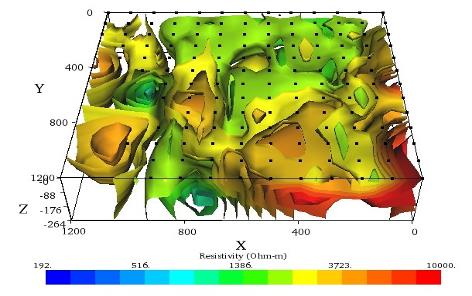
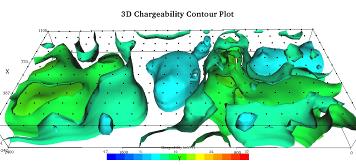
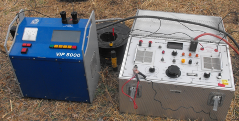
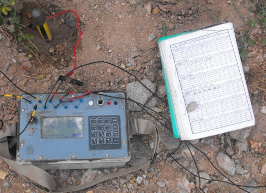
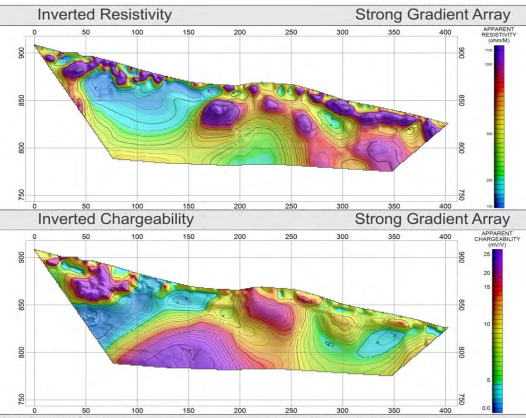
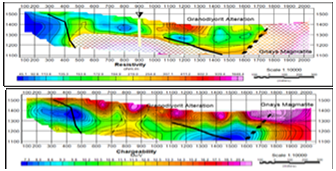
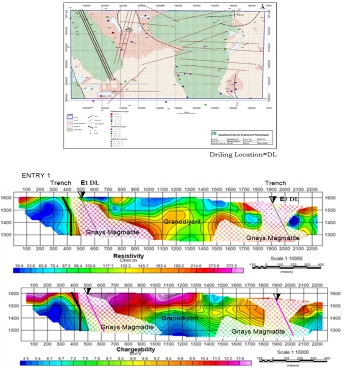
Induced Polarisation (IP) techniques are especially useful in exploration for disseminated sulphide mineralisation. The IP phenomenon is seen as a decaying voltage, lasting a few seconds,after a current transmitted into the ground is switched off. It is mainly due to diffusion of ions in groundwater at the surfaces of conducting mineral grains, so the total mineral-water surface area is important. Sizeable volumes of rock with a few percent of disseminated sulphide - such as porphyry or stratiform copper mineralisation, pyritic alteration with many gold deposits - are likely to show significant IP effects. Smaller bodies of semi-massive sulphides often give weak IP anomalies, but may be conductive enough to be detected using electromagnetic methods. |
|
Induced Polarisation (IP) techniques |







|
Home |

|
About Us |

|
Contact Us |
|
Back Survey |

|
Project |

|
Referances |

|
Certificate |

|
Equipments |


|
GEOLOGIST'S CONCERN: |
GEOPHYSICIST THINKS IN TERMS OF: |
APPLICABLE GEOPHYSICAL METHOD: |
|
foliation, bedding |
• anisotropy |
Resistivity, Seismic, CSAMT, IP, CR |
|
Metallic luster minerals |
|
|
|
disseminated |
• 0.2 to 5% minerals • weak conductor • low resistivity • moderate to strong IP |
Resistivity, IP, CR, SP, Magnetics, Seismic |
|
massive |
• greater than 10% mineralization • strong conductor • very low resistivity • moderate to weak IP |
Resistivity, CSAMT, TEM, FEM, Magnetics, Seismic, SP IP, CR |
|
alteration |
• high or low resistivity depending upon alteration type • weak magnetics • moderate to weak IP |
Resistivity, IP, CR (CLAYS), Magnetics, CSAMT, TEM, FEM, Radiometric, SP |
|
hydrothermal alteration |
• low resistivity • weak magnetics • potassium |
Resistivity, Magnetics, Radiometric, Seismic, IP, CR |
|
weathering |
• low over high resistivity • weak magnetics |
Resistivity, CSAMT TEM, FEM, Seismic, Magnetics, (IP) CR, Radiometric |